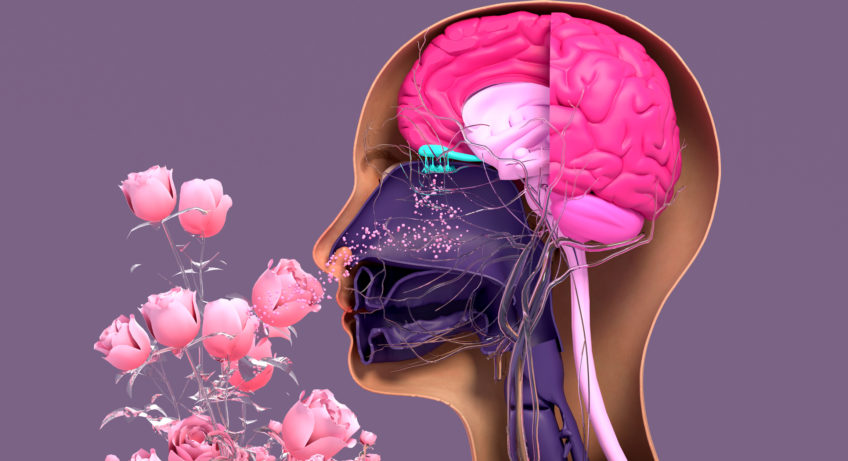
Françoise Couic-Marinier, Doctor of Pharmacy, and Marion Lemain, Physiotherapist, share their insights on the mechanisms of olfaction.
Have you ever experienced smelling an aroma that immediately transported you back years, right into the heart of a childhood memory? Do you recall those sensations and the immediate emotional connection to that olfactory memory?
The perception of an odor depends on the moment of its encoding, psychological and emotional context, as well as each individual’s personal experiences. There is a secondary alert system, known as the trigeminal system, which independently detects the freshness, pungency, or irritation of an odor, irrespective of the main olfactory system. In case of a malfunction in the olfactory system, the trigeminal system preserves the individual’s overall integrity.
The Mechanisms of Olfaction
Olfaction, the second sense to develop after touch, is defined at 3 months of pregnancy in the mother’s womb. As a result, the child incorporates into “their olfactory library” everything the mother eats and the smells she breathes, considering them as their own.
It was Richard Axel and Linda Buck, two American researchers who addressed the question of the olfactory mechanism, earning them the Nobel Prize in Medicine. This mechanism involves the functioning of nose cells that transmit odor information to the brain. In 1991, their work demonstrated the molecular identity of olfactory receptors, a vast family of thousands of genes enabling the distinction of numerous different odors. Each receptor is dedicated to a specific odor and is activated by molecular characteristics.
The lifespan of olfactory cells is approximately 45 days. Like amniotic fluid, they are located at the top of the nasal cavities and function in a liquid environment. Once the odor molecules are perceived by the receptors, the information is transmitted to the olfactory bulb and then to the primary olfactory cortex. The olfaction mechanism is an almost direct pathway to our unconscious mind!
Remarkable Studies:
In France, prominent neuroscientists like Luc Marlier, working at the CNRS in Strasbourg, have presented truly astounding results through their research on olfaction mechanisms and the invisible bonds that connect us to one another.
For instance, exposing a 2-hour-old infant to the smell of rancid butter immediately elicits a negative reaction. Conversely, letting the same infant smell vanilla extract or the scent of strawberries prompts them to open their eyes, flare their nostrils, stick out their tongue, and reach their hand towards the source of the smell, attempting to bring it closer to their mouth. Furthermore, it seems that maternal preferences can influence those of the child.
These remarkable findings contribute to significant advancements in the treatment of prematurely born or extremely premature infants (born before 7 months of pregnancy). Dispersing invisible vanilla extract in the incubator helps alleviate sleep apneas. In addition to the treatment, vanilla stimulates their olfactory and gustatory pleasure. Infants surrounded by this imperceptible fragrance regulate their heart rate, sleep better without the need for caffeine, eat more efficiently, and are discharged an average of 3 weeks earlier than other similarly premature infants treated with caffeine.
The Essential Oils and Their Physical and Emotional Impact through Inhalation
The Essential Oils and Their Impact
When our body experiences imbalance caused by stress, aging, or any specific health condition, inhalation is a highly effective method that directly affects the respiratory pathways. The potent compounds in Essential Oils release aromas that instantly send signals to the brain, particularly to the unconscious mind where emotions reside.
In the case of stress(1)
Some Essential Oils have properties that can reduce heart rate and blood pressure in adults. As a result, they are used by physicians and nurse anesthetists to prevent and alleviate the stress of patients about to undergo anesthesia. This significantly reduces the doses of injected anesthetics or other tranquilizers.
- 10 minutes of inhalation with Marjoram Essential Oil.
For elderly individuals.(2)
The inhalation of Essential Oils and other everyday scents can revive memories and stimulate the memory of a person with Alzheimer’s. Thanks to them, we directly connect with these memories, fostering communication and interactions. This ritualizes life moments in institutional settings.
Feeding Behavior Disorders and Depression(3)
Frequently employed as a support to conventional treatments, these scents stimulate and regulate the appetite of young anorexic or bulimic patients before their meals, restoring olfactory pleasure to depressed individuals who can no longer distinguish between the scent of a rose and that of vomit. These are just a few of the brilliant protocols implemented and used daily in our hospitals.
For athletes
For athletes, in addition to stress management, the pursuit of performance becomes crucial. The mental aspect plays a pivotal role in achieving the perfect movement or endurance. Nothing supports this better than Noble Laurel Essential Oil! Boosting self-confidence and enabling the tapping into necessary resources.
Moreover, Eucalyptus Radiata Essential Oil is effective in increasing concentration and memorization capabilities. On the other hand, Peppermint Oil can also be used as a stimulant and invigorator.
What about COVID?
The COVID-19 virus has highlighted a sense that has been underestimated for too long – the sense of smell. Indeed, during this viral infection, the olfactory system is disrupted, leading to anosmias (loss of smell), hyposmias (decreased perceptions), and phantosmias (constant phantom odors). Changes in smell can last from 15 days to several months. Edema of the olfactory epithelium prevents odor molecules from reaching the sensory cells. Nevertheless, the system is generally not completely destroyed.
This raises the question:
- issues related to eating problems, as only the taste buds then transmit information: sour, sweet, salty, bitter, and umami (monosodium glutamate).
- social handicaps: loss of alerts, smells of danger (smoke), anxieties about body odors…
- psycho-emotional issues: depression, detachment from the environment, and loss of reference points.
Olfactory Rehabilitation Protocol
Developed by the Anosmie.org association, Hirac GURDEN, and Jean Michel MAILLARD, you can download it directly from the association’s website.
Can I provide you with a summary?
The rehabilitation takes place over 12 weeks, with twice-daily sessions of 5-minute olfactory stimulation. It is recommended to use 4 to 6 scents, mostly from Essential Oils. An olfactory sensitivity test in an Ear, Nose, and Throat (ENT) department and a consultation before and after rehabilitation may be considered to assess the results objectively.
Which Essential Oils to use?
These authors of the protocol have chosen these Essential Oils for their differences and characteristics that are unique to them:
- The Essential Oil of Lemon (Citrus limon)
- The Essential Oil of Clove (Eugenia caryophyllus)
- The Essential Oil of Rose (Rosa or geranium)
- The Essential Oil of Eucalyptus globulus
- The Essential Oil of Peppermint (Mentha piperata)
- The scent of coffee beans
Equipment to use :
- A tracking notebook to fill in after each olfaction.
- 6 identical opaque glass bottles of 100 ml each containing Essential Oils diluted to 2% in 50 ml of water. Approximately 20 drops for 50 ml of water. Essential Oils are not soluble in water, and the scent of carrier oils may disrupt the effectiveness of the treatment. Therefore, shake the bottles before each use. Store your bottles away from light and heat for a duration of 15 days.
- Labels to identify the bottles. To be stuck under the bottles so that they are not identifiable during olfaction.
How to proceed ?
- Setup:
- Settle comfortably in a quiet space, away from meals and toothbrushing, in a neutral room without olfactory disturbances: Avoid kitchen smells and scented candles.
- Breathe:
- Place the bottle about 2 centimeters below the nose for 30 seconds, sweeping it from left to right to allow the odor molecules to diffuse through the nostrils.
- « Breathe consciously, seek calmness, and let the perception come. ».
- No stress! There’s no need to identify the scents; the goal is simply to detect them.
- Take a break between each bottle.
- Position your bottles :
- Smell the bottles randomly, one after the other, then place them based on your perceptions. On the left, certainty of having detected a scent, in the middle, uncertainties, and on the right, no sensation. Record in your tracking notebook.
- You can later smell again the bottles in which you perceived a sensation, associating this time the image and the source of its origin. This will help you to fix them in your « olfactory library ».
So now, don’t hesitate! Smell and feel!
(1) Jacques MARCHAND, The use of aromatherapy in the treatment of stress and insomnia. Doctoral thesis, Faculty of Lorraine (2019)
(2) Article Plantes & Vie (April 2019) – Françoise Couic-Marinier ‘Alzheimer, don’t let your neurons fly away’
(3) Van der Ploeg et al. BMC Geriatrics (2010) / http://www.biomedcentral.com/1471-2318/10/49“