




VENTILATION
Ventilation is the set of means used to air an enclosed space and renew the air in order to purify it, with or without the use of fans.
The main functions of ventilation are :
■Ensuring indoor air quality;
■Preventing the accumulation of moisture and unpleasant smell;
■Reducing the concentration of pollutants and toxic gases;
■Preserving the building structure.
There are different ventilation systems:
- Natural ventilation
Natural ventilation relies on the circulation of air in the building without the use of fans. The air moves due to the difference in pressure between the facades and the difference in density depending on its temperature (under the effect of the wind and thermal draft). The driving pressure due to the thermal draft is proportional to the height of the ventilation duct and to the temperature difference between the interior and exterior of the room to be ventilated.Despite the fact that this system requires no electrical consumption and requires little maintenance, it has shortcomings and limitations and cannot always be recommended.
- Mechanical ventilation
The mechanical ventilation ensures constant ventilation flow rates in the building regardless of the weather conditions. Mechanical ventilation is provided by fans and air handling units that we can offer according to the needs and technical study of your project.We guarantee the design and implementation of your project according to Moroccan and international standards. The sizing of the mechanical ventilation systems will be based on the NM 10.5.022 standard (EN 13779) and the NF DTU 68.3P1-1-1.
- Mechanical ventilation and the hospital environment
The ventilation in the hospital environment is mainly concerned with low-contamination risk areas (administrative and medical offices, consultation rooms, certain hospital units with no major risks, etc.).
In general, for areas with medium or high contamination risks, air conditioning is often difficult to avoid. For the hospital environment, there are other standards that help to regulate air treatment. The NFS 90-351 standard defines different zones according to the risks involved : the risk zones.- Areas classified as risk 4 (very high infectious risk);
- Areas classified as risk 3 (high infectious risk);
- Areas classified as risk 2 (medium infectious risk).
Following the level of risk in these areas, different types of airflows are defined (unidirectional or not) with a variation in mixing rates (given in volume/hour).
Ventilation in the hospital sector is a complex process that requires expertise in the field. Contact us for design and installation.
- Technical equipment
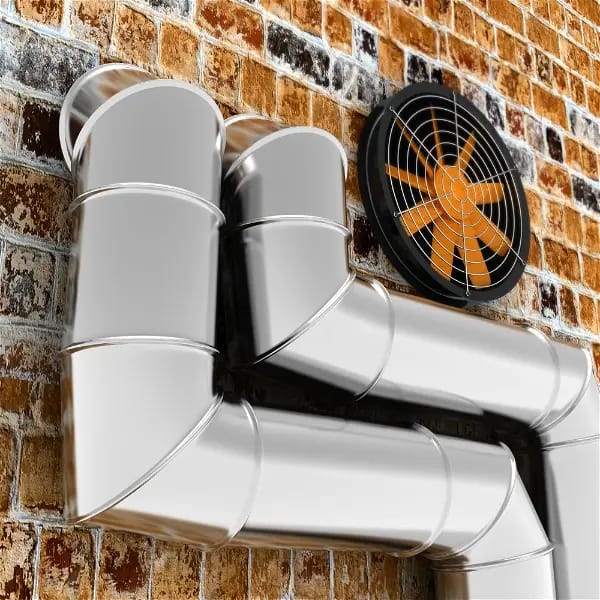
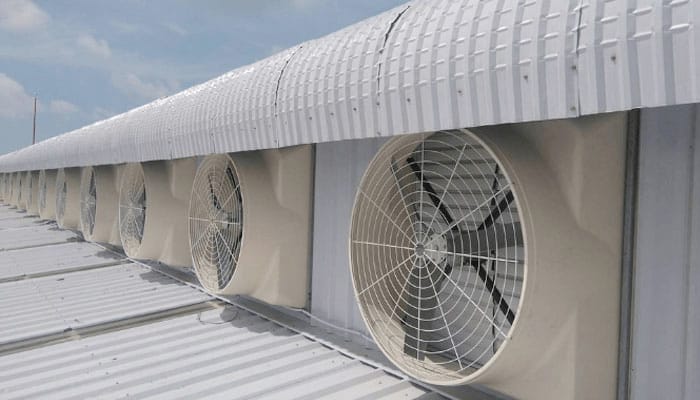
- Ventilation box : The ventilation unit (also called an extraction or supply unit) is a turbomachine that transfers the necessary energy to the air that passes through it in order to transport it through one or more ducts, or to sweep a space. There are several types of ventilation units according to the needs, nature, and requirements of the project.
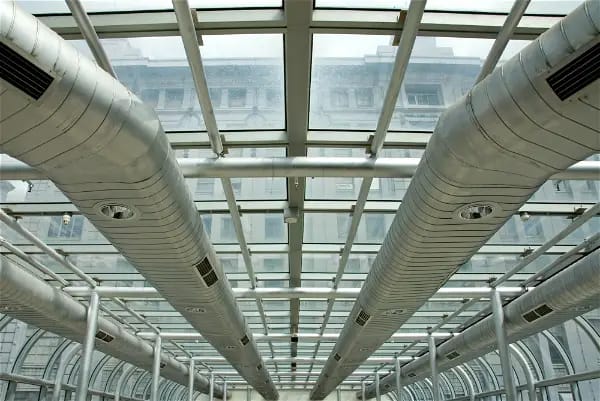
- Ventilation ducts : The materials constituting the distribution ducts are generally made of :
- Galvanized steel
- Aluminium;
- Inox;
- Plaster;
- Synthetic material (PVC, textile, polyethylene, etc.).
The main shapes of the ducts are :
- The cylindrical or circular ducts;
- The oblong ducts;
- Rectangular ducts.
- Adjustment damper : The adjustment damper is a device of rectangular or circular shape depending on the duct, it is used to balance and adjust the air flow in the network by creating pressure drops.
- Sound trap : Also known as a silencer or attenuator, the sound trap is a device designed to capture sounds in the airflow, it is used to reduce the amplitude and power of a noise. The attenuation is achieved as the air passes through the absorbent elements (such as rock wool or similar). Baffles in the form of vanes help to improve its efficiency. Different types of sound traps can be used depending on the required acoustic performance and different operating parameters.
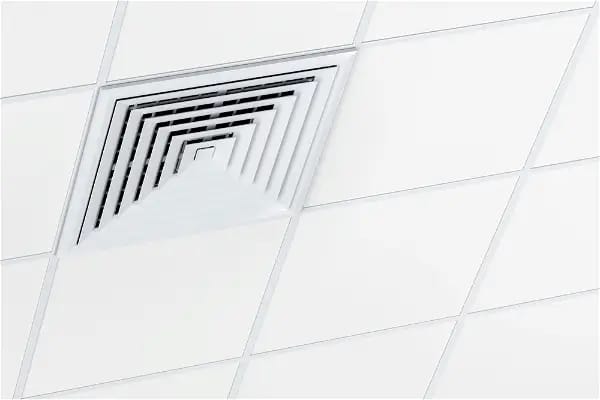
- Grilles and diffusers : The ventilation grille and diffuser is the terminal device of a duct carrying air between a ventilation system and the space of a building. There are several types of grille and diffuser depending on the location, architecture, design, and budget.
- Filtres, The filters are used to:
- Purify the air from pollutants : fungi, allergenic and pathogenic bacteria, fiberglass particles, and more.
- Protect the premises' equipment (electronics, photography, etc.) from dust to increase their lifespan and reduce maintenance needs.
- Protect the ventilation system itself. Without filtration, deposits can accumulate in the ducts, joints, distribution outlets, exchange coils, fans, registers, and control probes. The accumulation of dust can lead to the proliferation of fungi, bacteria, and other contaminants.
- Prevent the spread of fire through dust and the risks of explosion.
- Protect terraces and roofs by not releasing particles directly outdoors.
Porous layer filters are classified based on their efficiency :
- Medium efficiency filters (classes G1 to G4);
- High-efficiency filters (classes F5 to F9);
- Very high-efficiency or absolute filters (classes H10 to H14);
Do you have an installation or renovation project?
Our technical team is at your disposal to help you assess the thermal balance and choose the equipment suitable for your project.


CET Building, a company specialized in the design and implementation of comprehensive and coordinated services across all technical specialties.
Together, let's contribute to realizing your energy projects, as diverse and varied as they are specialized.